

Chatbot, Automation, or Judgement Containers?
Your judgment is trapped in your head. Chatbots and automation can't carry it. Something else can.

In this issue: A third way to think about AI that most people haven't considered. The four layers that separate a clever prompt from encoded judgment. And a mirror to find the 3-4 skills already living in your head that you've never written down.
You made at least a dozen judgment calls today that nobody saw.
You pushed back on a client’s direction instead of letting them run with it. You read a room and knew the deal wasn’t going to close before anyone said it out loud. Someone was telling you a story, circling around the real problem, and you asked the one question that cut straight to it. Something happened in a meeting that felt like progress but you could tell it was a detour that’ll cost you two weeks.
You’ve been making calls like these for years. Probably a decade or more. You’re fast at it now. So fast that most of the time you don’t even register you’re doing it. It just happens. You listen, you process, you decide, and you move on.
But here’s the thing about that speed: it made the thinking invisible. Not just to everyone else. But also to you.
You can’t hand it off because you can’t explain it. Every time you step away, something slips that wouldn’t have if you’d been in the room.
Your team doesn’t lack talent. They lack access to the pattern you’re running. And you can’t give them access to something you can’t see yourself.
So what do you do with that? Most people, at some point, try to solve it with AI. Which is the right impulse. But the approach they use determines whether it works or doesn’t.
The two defaults
Most people I talk to think about AI in one of two ways.
The first is the chatbot. Ask a question, get an answer. This is how most people start. You type something into Claude or ChatGPT, it responds, and you evaluate whether the response is useful.
Sometimes it is. Often it’s generic. The model doesn’t know your team, your context, your priorities, or the twelve things you considered and rejected before arriving at your actual answer. It’s working from a blank slate every time.
The second is automation. If X happens, do Y. This is where most “AI workflow” content lives. Connect your tools, build a pipeline, trigger actions automatically.
It works beautifully for things that follow predictable rules. It falls apart the moment the situation requires judgment.
And the work that matters most, the work that made you the person everyone depends on, is almost entirely judgment.
The chatbot is generic. The automation is brittle. Neither one can carry the thing that actually makes you good at your job.
There’s a third approach. I haven’t seen many people talk about it, but it’s the one that changed how I think about all of this.
Something else entirely
A judgment container.
Think about it this way. A chatbot gives you its best guess at what you might want. An automation does exactly what you told it, whether or not the situation calls for it. A judgment container holds the shape of how you actually think, your methodology, your criteria, your guardrails, and applies it consistently (ideally) while you review the output.
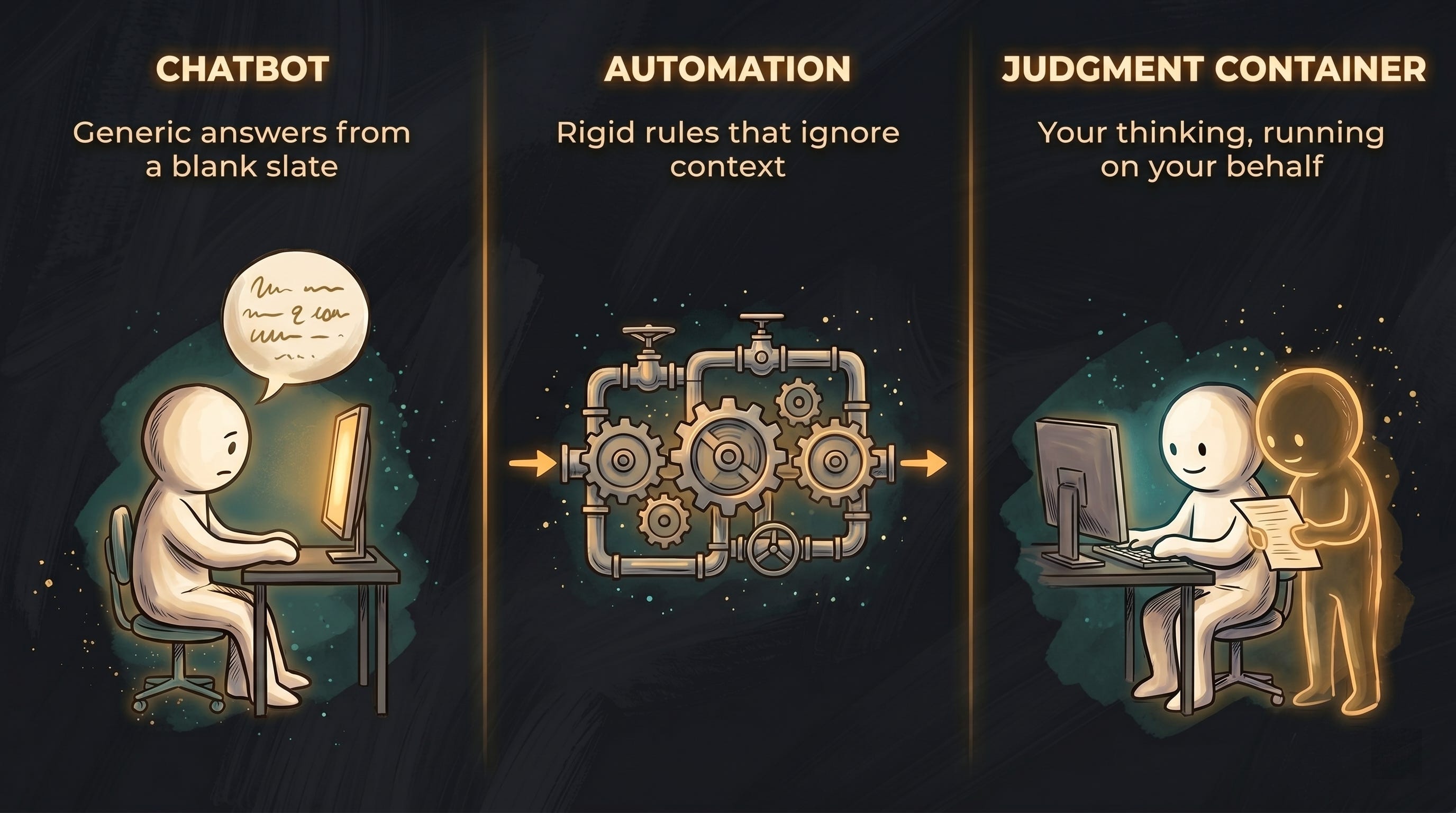
That’s the difference. A judgment container does what you would do, because you taught it how you think, and then it waits for you to confirm before anything happens.
It’s closer to what it feels like to have a really smart colleague who’s watched you work long enough to know your patterns. Someone who routes things the way you’d route them, flags what you’d flag, cuts what you’d cut. Not perfectly. But well enough that your job shifts from doing the work to reviewing it.
The interesting part is that building one forces you to do something most people never do: articulate the judgment that’s been running in your head on autopilot.
And that turns out to be the hardest part. It’s not the technology or the setup. It’s the act of looking at a decision you’ve made a thousand times and breaking it down into the sequence of questions you actually ask, in what order, with what criteria.
I’ve spent many years making a particular set of judgment calls every week before I tried to write them down. When I finally did, I realized I couldn’t get past the second step without saying “it depends.” And “it depends” was covering about fifteen decision rules I’d never consciously separated.
Most people discover the same thing. They never had a reason to pull the judgment apart. It just worked. Until it needed to scale.
If you’ve used Claude or worked with AI agents, you may have heard the term Agent Skill. Anthropic defines skills as instructions that teach AI how to complete specific tasks in a repeatable way.
And many people build them that way. Procedures. Checklists. Step-by-step instructions for formatting a report or processing a form.
Those are fine for predictable work. But the skills that actually change how you work are the ones that carry your judgment. Your decision criteria. Your methodology.
The “it depends” logic that lives in your head and nowhere else. That’s what turns a Agent Skill from a glorified template into something that thinks the way you think.
A skill is how you take the judgment out of your head and put it somewhere loadable.
The anatomy of a skill worth building
Every time I've turned invisible judgment into something loadable, the same four layers show up. When one is missing, the thing breaks. When all four are present, it works at a level that surprises people, including me.
(The first time I saw my own decision process run without me, I spent ten minutes checking whether it had actually gotten the routing right. It had. That was a strange but very exciting morning.)
Here’s what I found those layers to be:
Methodology. The decision sequence you actually run. The specific questions you ask, in the specific order you ask them, when this type of work lands on your desk.
Most people have never written this down. It’s the most valuable layer and the hardest to see from the inside.
Context. The state of your world. Who your people are, what they’re working on, what the current priorities are, what’s already been decided. No AI has any of this unless you give it. Without context, even perfect methodology produces generic results.
Workflow. The deterministic shape of the work. What goes in, what comes out, in what order. Every step has one job, with a defined input and a defined output. Without this structure, even good judgment produces inconsistent results because there's no container for it to run in.
Guardrails. The things you would never do, even if they looked helpful. This is where many AI projects fail and where the best ones are strongest.
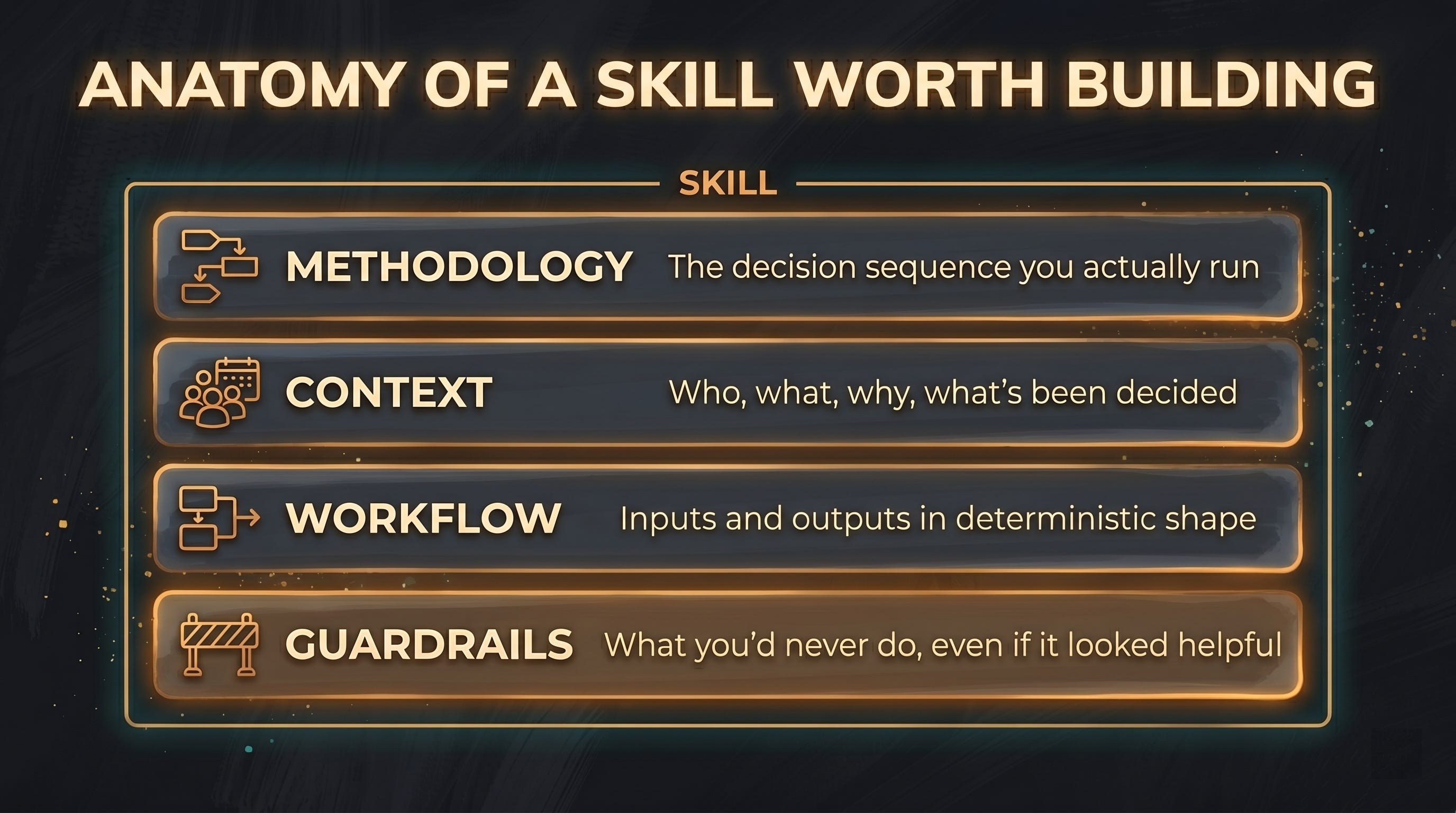
If you’re missing one of these layers, you have either a clever prompt or a brittle script. Both are worse than no skill at all, because they create the illusion of a system without the reliability of one.
The mirror
You have three or four of these skills living in your head right now.
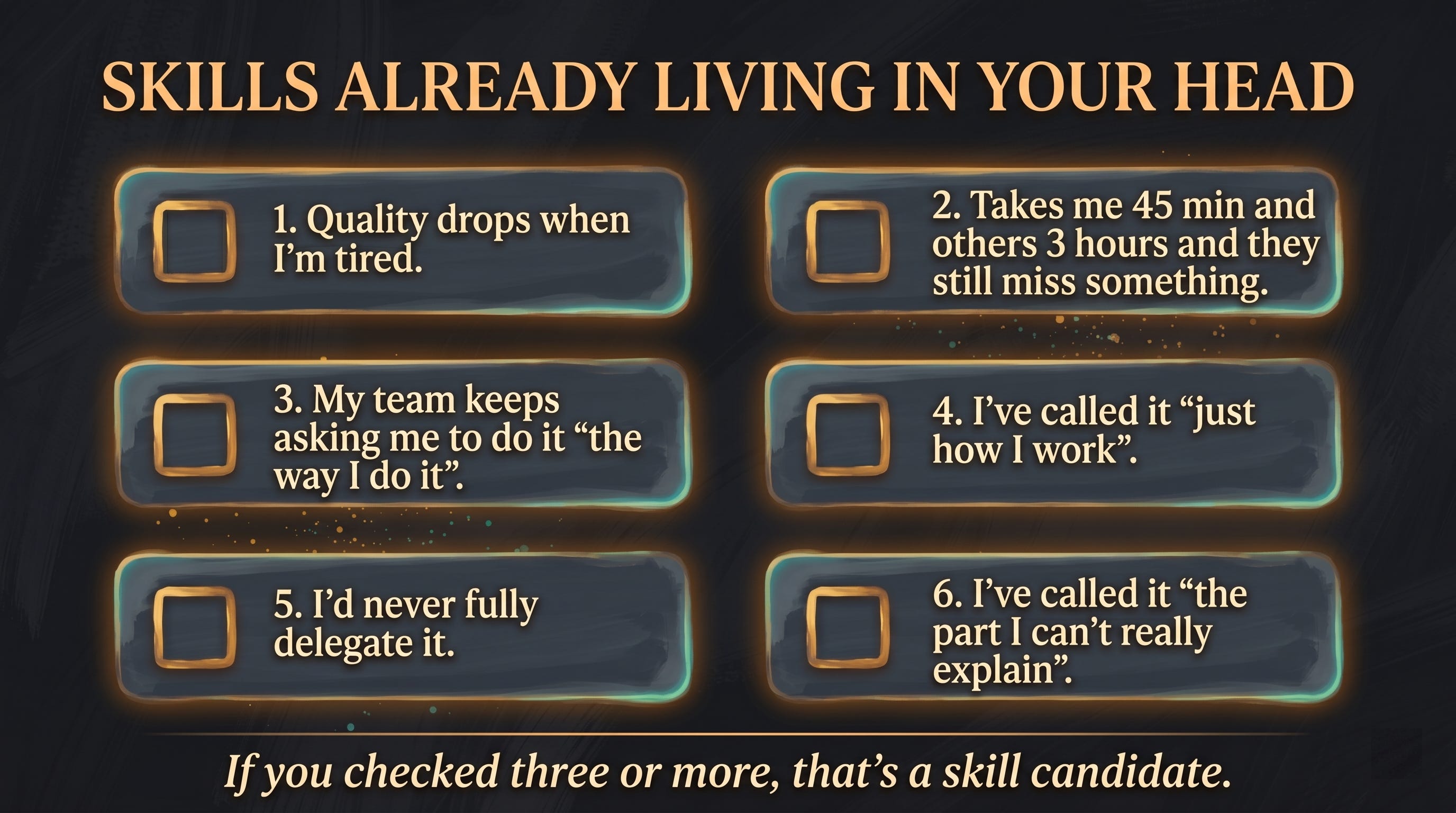
They’re the work where your quality drops when you’re tired. The thing your team keeps asking you to do “the way you do it.” The judgment call you’d never fully delegate but would love to stop carrying alone every week.
You’ve called it “just how I work.” Or “the part I can’t really explain.” Or “the thing that takes me 45 minutes but would take anyone else three hours, and they’d still miss something.”
That language is what keeps it stuck in your head. It sounds like a description of talent. It’s actually a description of a system that was never written down.
The hardest part, honestly, is seeing your own patterns clearly the first time. The layers feel obvious when someone else names them back to you. But they’re nearly invisible when you’re the one running them.
The most valuable thing you own is the shape of your thinking.
Next week, I’ll show you what it looks like when you take one of those and actually build it. A real skill I shipped, with the before and after, the decisions I made, and the parts that surprised me.
In the meantime, try this. Paste the prompt below into Claude or ChatGPT. It will interview you about your week, spot where your judgment is doing invisible work, and name your skill candidates back to you.
You're going to help me find where my professional judgment is doing invisible work. Interview me about my week, then tell me which tasks are "skill candidates" worth encoding into AI.
Start by asking me to walk through yesterday, hour by hour. Don't let me summarize. Push for specifics. As I talk, listen for these signals:

Someone needed my opinion, not just information
A less experienced person would have handled it differently and probably gotten it wrong
I did something on autopilot that actually requires years of pattern recognition
I said "it depends" (that phrase almost always means hidden judgment)
I translated something complex into something simple for someone else
I've explained this same thing dozens of times and wish it could just be done my way

When I say "I just do it," push back. Ask things like:

"Walk me through the first 30 seconds. What do you look at first?"
"What would a new hire get wrong about this?"
"When was the last time someone did this without you and it went sideways?"

After we talk through my day, reflect back 2-3 candidate tasks where my expertise is doing hidden work. For each one, name the specific judgment involved (not "you use your experience" but the actual decision points), how often I do it, and what goes wrong when someone else tries.
-Tam